Why I Built an ADHD To-Do List and Planner That Also Helps People With Menopause, Perimenopause and Scatter Brains Remember Things
I built Do1Thing, an ADHD to-do list and planner, for my own scattered brain. It helps with menopause and perimenopause brain fog too. Here's why, and how.

10 min read
Contents
I’m Lee. I’ve got ADHD (the high-functioning kind), which mostly means I looked fine from the outside while quietly dropping things left, right and centre. I’ve tried every ADHD to-do list, planner and productivity system going, and most of them made things worse.
So I built my own. It’s called Do1Thing, and this is the story of why it exists, what it does differently, and the simple framework at the heart of it: One Thing, Soon and Someday.
And it turns out it isn’t only ADHD brains that need it. If you’re going through menopause or perimenopause, or you’ve simply always been a bit of a scatter brain, the same framework helps you remember the things that matter.
If your brain has ever held fifty open tabs while you sat staring at a to-do list, unable to start any of it, this one’s for you.
The tell: birthdays, anniversaries and that drop in my stomach
For years, prioritising was a coin toss. I’d forget the things that mattered most and remember everything that didn’t. I never really knew what was coming next.
Birthdays and anniversaries were the tell. I’d remember on the day, or the day after, and get that familiar drop in my stomach. Not because I didn’t care. My brain just doesn’t hold the dates.
If you have ADHD, you probably know that feeling. You know the thing matters. You even know exactly what to do about it. And then it slips anyway, and you’re left explaining to someone you love that no, really, it wasn’t that you didn’t care.
Dr Russell Barkley, one of the world’s leading ADHD researchers, puts it better than I can:
“ADHD is a disorder of performance, of doing what you know rather than knowing what to do.”
— Dr Russell A. Barkley, Taking Charge of Adult ADHD
That line changed how I thought about my own brain. I didn’t need more information, more apps or a better colour-coding system. I needed something that would help me do the thing I already knew I needed to do, at the moment it needed doing.
Why the usual to-do list doesn’t work for ADHD brains
Here’s the problem with a normal to-do list: it shows you everything, all at once.
Forty-seven things, sitting there in a column. Some urgent, some not, some three years old. Every time you open it, your brain has to decide what matters most, from scratch, again. For an ADHD brain, that decision is the hardest part of the whole job. So you scroll, you feel the weight of it, and you close the app. Then you do something easier instead.
The list stops being a tool and becomes a wall of guilt.
Dr Edward Hallowell, who has written some of the most hopeful books on ADHD, describes the ADHD brain like this:
“A person with ADHD has the power of a Ferrari engine but with bicycle-strength brakes.”
— Dr Edward Hallowell, ADHD 2.0 (read more)
A to-do list that shows you everything is like asking that Ferrari to pick a direction while every road is open at once. What it really needs is fewer roads.
So I stopped trying to be organised like everyone else
At some point I gave up trying to be organised the way everyone else is. Instead, I built a framework that works the way my brain does:
- One thing at a time. Just one. Everything else waits its turn.
- Soon and Someday for everything else, so nothing gets lost but nothing gets in the way either.
- Nudges that don’t let me off the hook, because good intentions on their own have never been enough.
- Birthdays and events where I’ll actually see them coming, instead of finding out on the day.
I’ve spent 30 years thriving with ADHD, and I’ve built a whole career on this approach. Nothing falls through the cracks now. Not a birthday, not a deadline, not the small promises. I know what today is and what’s next, and that quiet has changed everything.
Do1Thing is that framework, turned into an app.
The Do1Thing framework: three buckets, zero noise
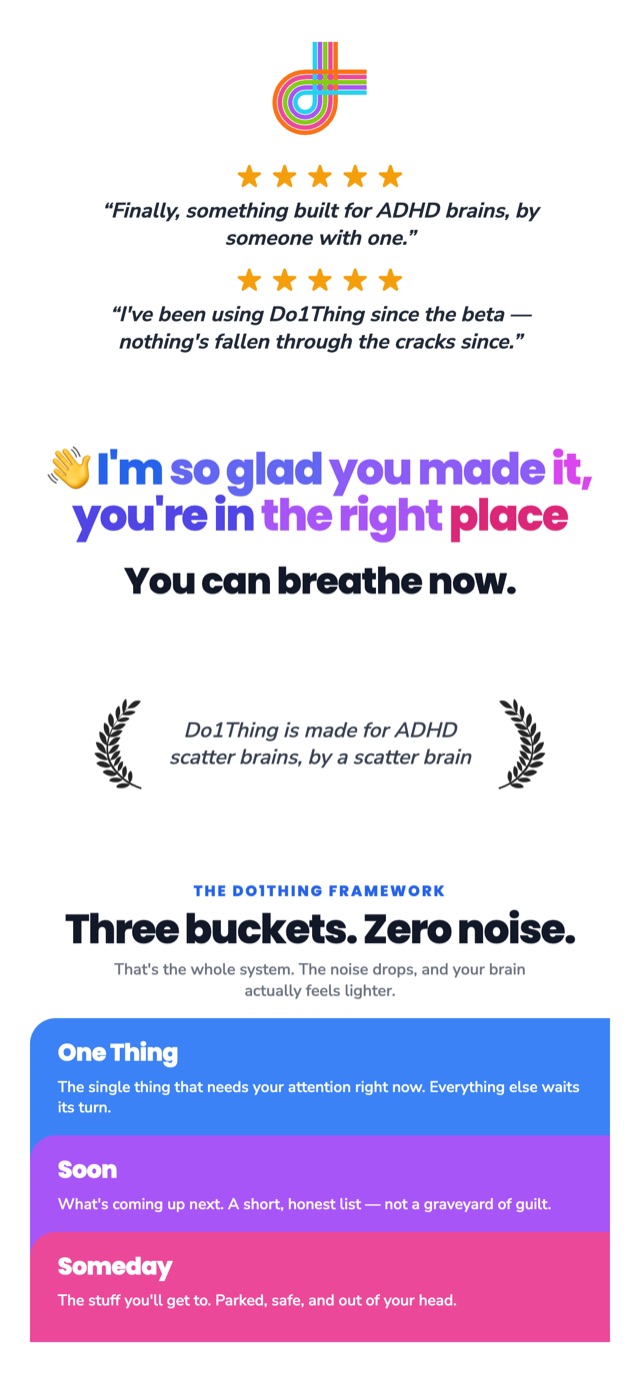
The whole system is three buckets. That’s it. The noise drops, and your brain actually feels lighter.
One Thing
The single thing that needs your attention right now. Everything else waits its turn.
Soon
What's coming up next. A short, honest list, not a graveyard of guilt.
Someday
The stuff you'll get to. Parked, safe, and out of your head.
Let’s go through them one at a time (fittingly).
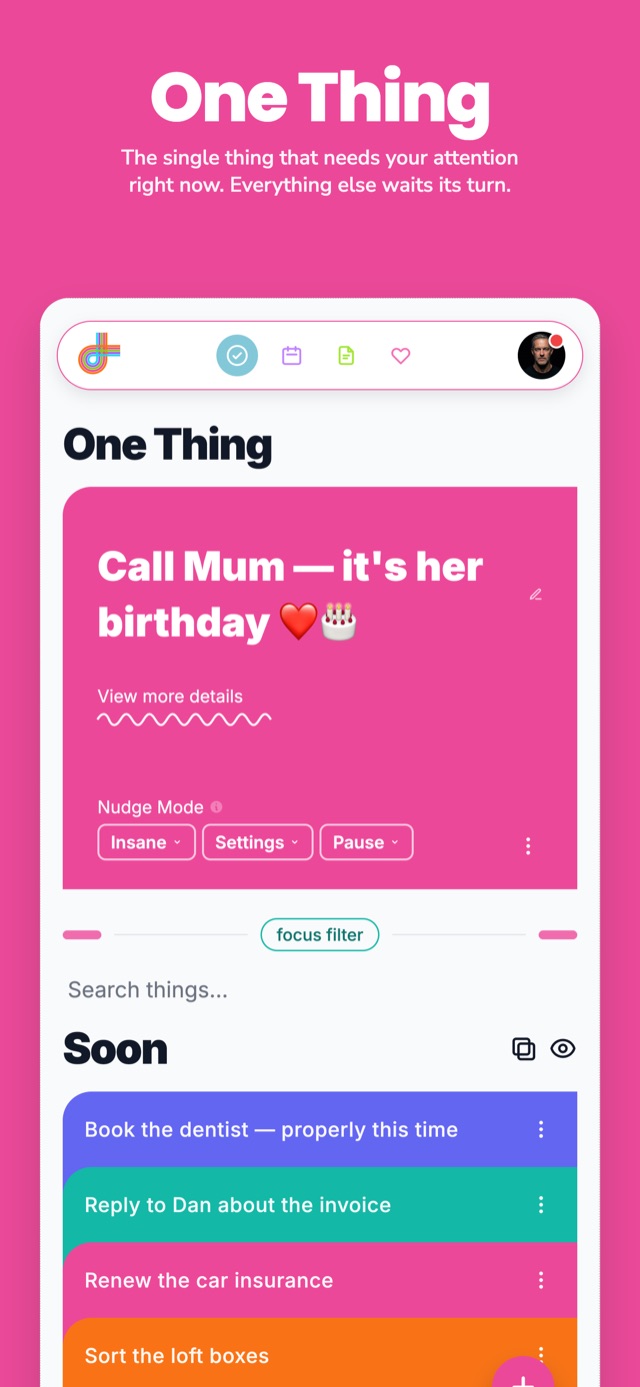
One Thing: the only thing on your plate right now
Your One Thing is the single thing that needs your attention right now. It sits at the top of the app, on its own, big and bright, in a colour you choose.
You don’t see a list. You don’t have to decide anything. When you open Do1Thing, the question “what should I be doing?” has already been answered, by you, at a calmer moment.
That’s the benefit, and it’s a big one: the decision is already made, so you can just start. No scrolling, no weighing up, no getting lost in the list. When it’s done, you pick the next one, and the satisfying bit (ticking it off) actually feels like progress, because it’s the only thing you were doing.
Soon: a short, honest list (not a graveyard of guilt)
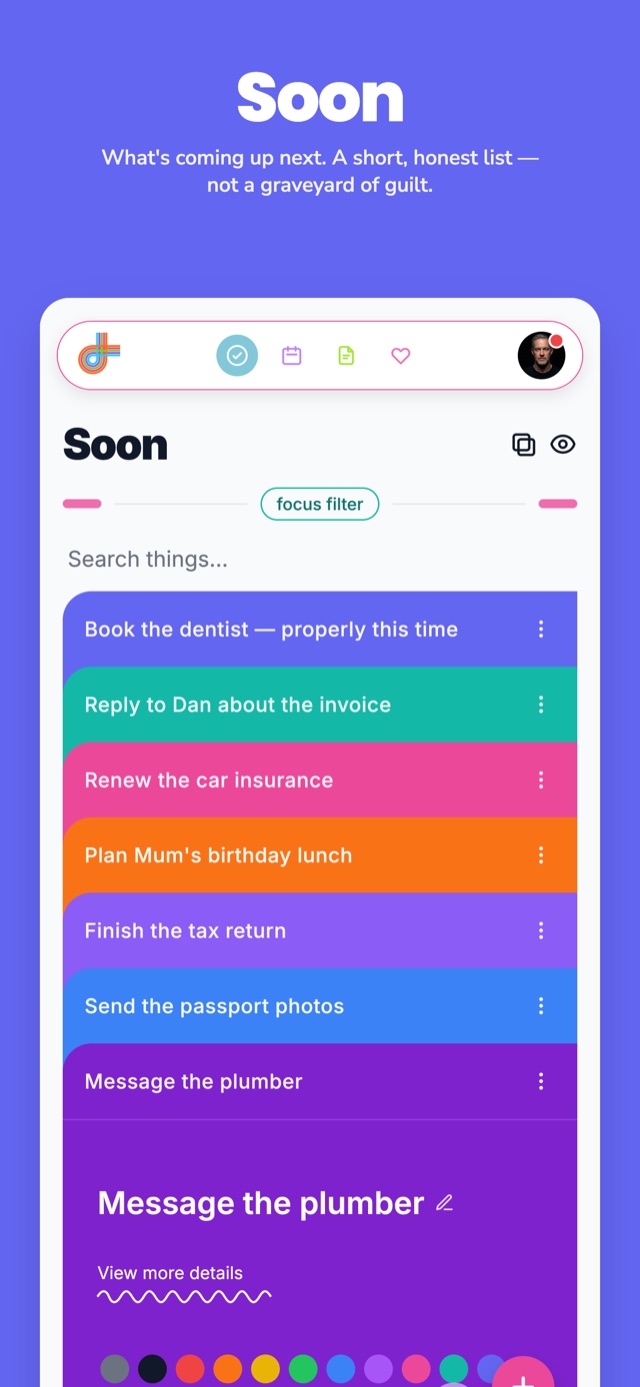
Soon is what’s coming up next. It’s deliberately short and deliberately honest.
Most to-do lists turn into graveyards: things you added with good intentions months ago and now avoid looking at. Soon isn’t that. It’s the handful of things genuinely next in line, in the order you want to do them. Drag them around, and when your One Thing is done, promote the next one up with a tap.
What it gives you: a clear “what’s next” without the dread. You can glance at Soon, feel fine about it, and get back to your One Thing.
Someday: parked, safe and out of your head
Someday is for the stuff you’ll get to. The book you want to read, the shelf you keep meaning to put up, the idea you don’t want to lose. It’s parked, safe, and out of your head.
David Allen, creator of the Getting Things Done method, nailed why this matters:
“Your mind is for having ideas, not holding them.”
— David Allen, Getting Things Done
GTD has its own “someday/maybe” list, and the idea is the same: if a thought is safely captured somewhere you trust, your brain can stop holding onto it. For an ADHD brain that’s constantly juggling, that’s a genuine relief.
Do1Thing adds one thing I always wanted from a someday list: a bounce back. Park something in Someday and have it pop back up into Soon later, so “someday” doesn’t quietly become “never”.
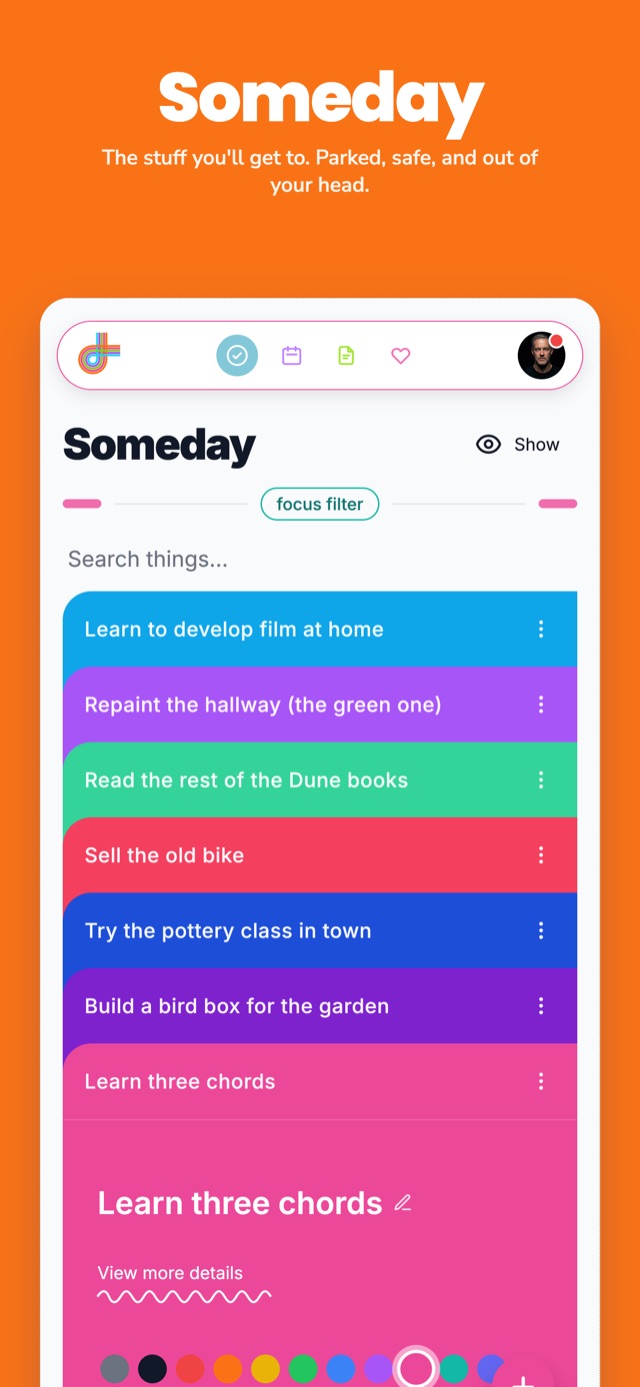
Want to see how it feels before downloading anything? There’s a live demo of the framework on do1thing.net. No account, nothing saved, just the app being the app.
Nudges that don’t let you off the hook
Here’s where most to-do apps lose ADHD brains: the reminder. One polite notification, easily swiped away, and the thing is gone again.
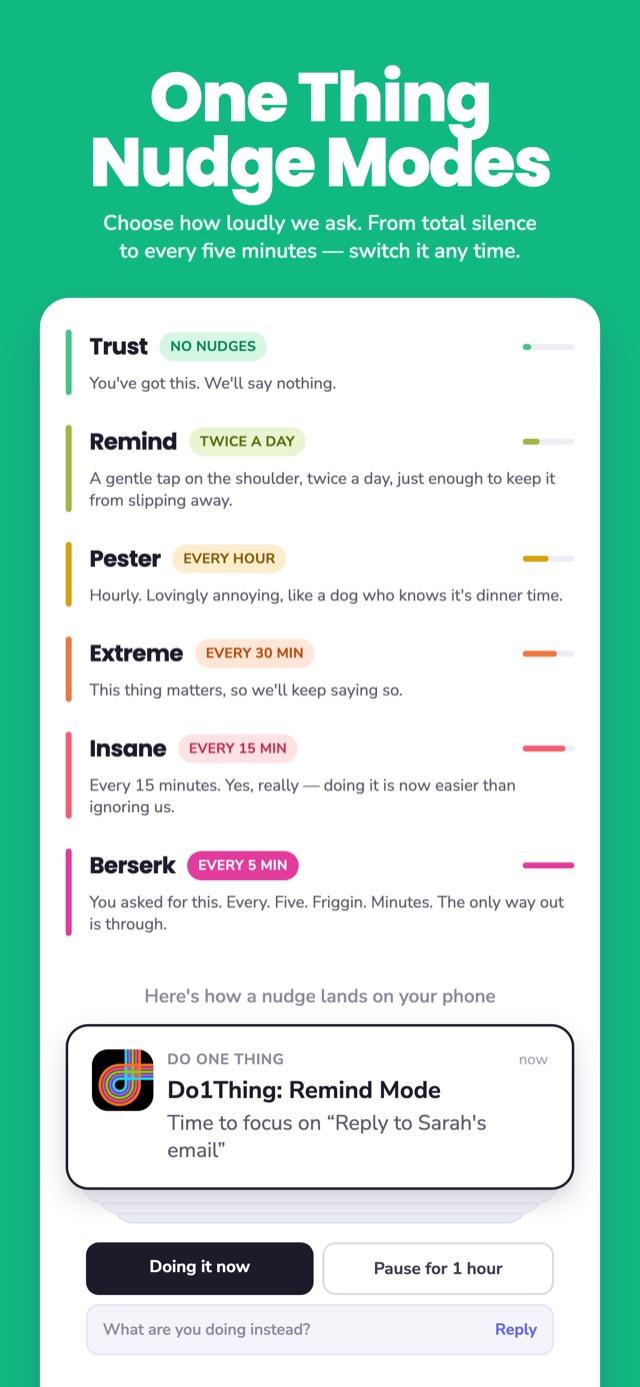
Do1Thing lets you choose how hard it pushes you, separately for every thing. I call them Nudge Modes, and they go from gentle to relentless:
- Trust: no nudges. You’ve got this.
- Remind: twice a day. A gentle tap on the shoulder.
- Pester: every hour. Lovingly annoying.
- Extreme: every 30 minutes. This thing matters.
- Insane: every 15 minutes. Doing it is now easier than ignoring us.
- Berserk: every 5 minutes. You asked for this. The only way out is through.
The benefit isn’t the notifications themselves. It’s that you decide, in advance, how much help future-you is going to need. A birthday card might be fine on Remind. A tax return due on Friday? That’s going on Berserk.
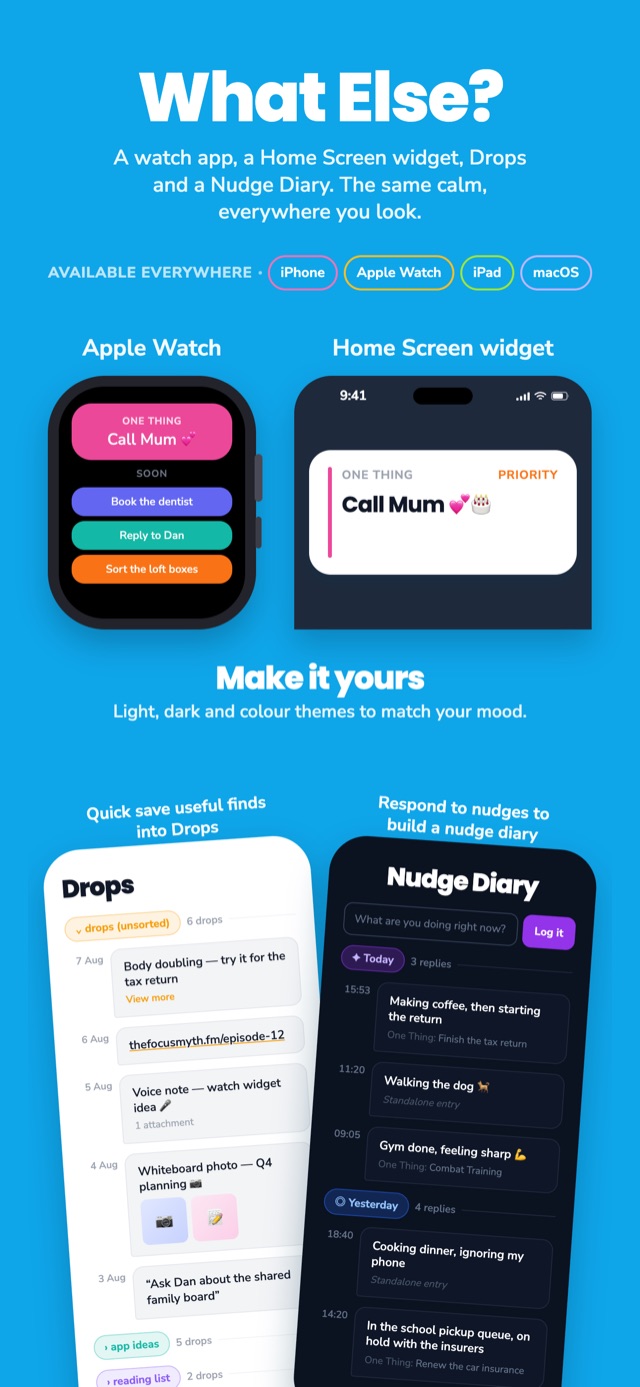
And when a nudge arrives at a bad moment, you can press and hold it to pause for a while, or reply to it. Your reply lands in your Nudge Diary, so you can see what actually got in the way, without the guilt.
Built for the way life actually goes
Real life isn’t just a list of tasks, so Do1Thing doesn’t pretend it is. A few of the things that make the framework stick:
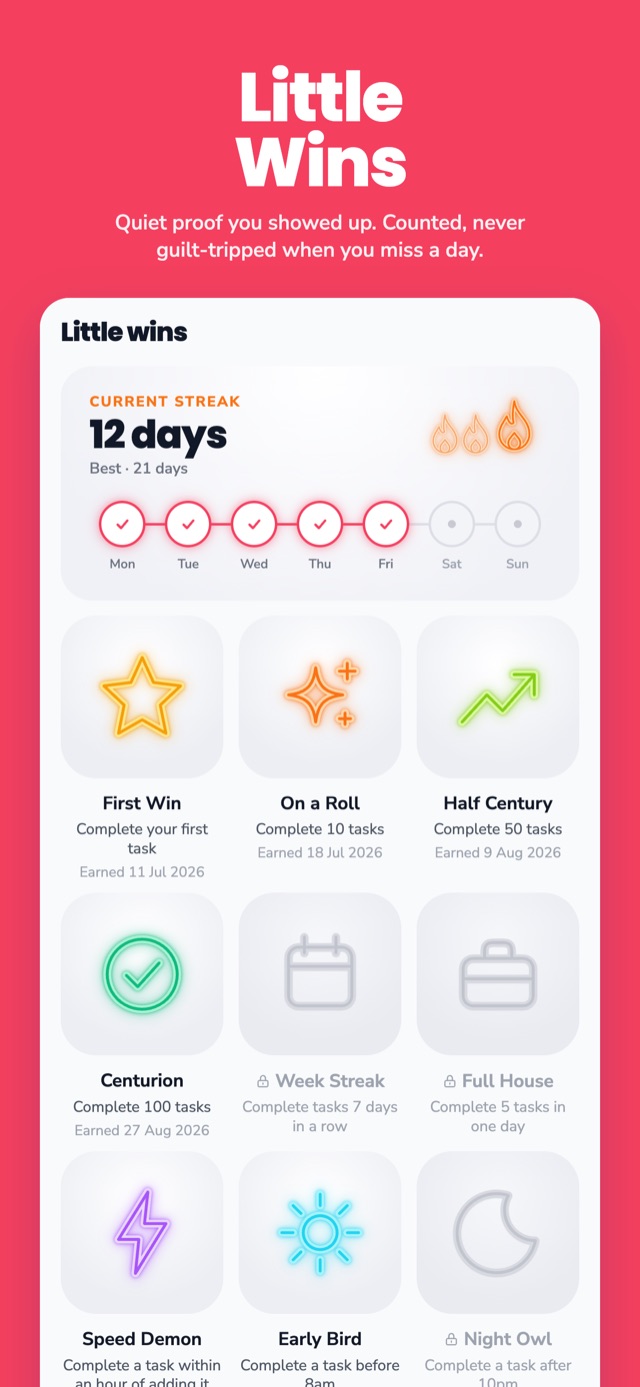
- Little wins. Every thing you finish feeds a streak and lights up a badge. It’s built for real life, not guilt: the point is to notice progress, not punish a bad day.
- Flow. Every finished thing lands in Flow, sorted by label and counted by day, week, month and year. On the days your brain insists you’ve done nothing, Flow shows you otherwise.
- Drops. Share a stray link, photo or thought into Drops in a second, and deal with it later. Capture is instant, so ideas don’t evaporate while you look for the right place to put them.
- Everywhere. Your One Thing follows you across iPhone, Apple Watch, iPad, Mac and the web. Glance at your wrist, and the answer to “what am I doing?” is right there.
- Birthdays and events you’ll see coming. With Do1Thing Pro, events, birthdays and anniversaries show up in your Today and Tomorrow strips and a days-ahead view, so you’re ready before the day, not apologising after it. (Yes, this one’s personal.)
Your head, your data
What goes into a to-do app is personal: worries, plans, birthdays, the stuff you don’t say out loud. I built Do1Thing to keep it that way. There are no analytics, no ad pixels and no cross-site tracking. Your data is encrypted in transit and at rest, and the words in your things and notes are encrypted at field level too. You can export everything or delete your account whenever you like, and it’s never sold. The full privacy promise is on do1thing.net.
Why I’m launching Do1Thing now
I built Do1Thing for myself first. For a long time it was just my system, quietly keeping my life together.
Then came the beta. Two things beta testers said have stuck with me ever since, and they’re now on the Do1Thing homepage:
“Finally, something built for ADHD brains, by someone with one.”
“I’ve been using Do1Thing since the beta — nothing’s fallen through the cracks since.”
And it isn’t only for ADHD brains. The forgetfulness and brain fog that come with menopause and perimenopause can feel very familiar, and the same three buckets work just as well there.
That’s why I’m launching it properly, and why this blog exists. Here I’ll write about living and working with ADHD, the productivity ideas that actually help, practical guides to getting the most from the framework, and what’s new in the app. You can follow the ADHD posts, or subscribe below and get them by email.
If Do1Thing helps one other scattered brain breathe out, that’s the whole point.
Try the framework yourself
You don’t need to change who you are to get things done. You need fewer roads, one at a time.
Do1Thing is on iPhone, iPad, Apple Watch, Mac and the web. Start on Basic with a free trial, then it’s £2.99 a month. Move up to Pro (£5.99 a month) when you want events, birthdays and the full life system. You can switch or cancel any time in the App Store. See pricing.
If you’re wondering whether you might have ADHD yourself, the NHS guide to ADHD in adults and CHADD are good, trustworthy places to start.
Thanks for reading. Now go and do one thing.
Lee